If there's one thing I can say with some authority (as an anthropologist's apprentice, amateur linguist, and sometimes lover), it's that for all the words we've adapted from other languages, the fact that we only have one word for 'love' tells us something distressing about ourselves. Not that speakers of languages who more finely divide the semantic space occupied by 'love' are in any way more likely to be kinder, more compassionate, or selfless than speakers of English, but it makes you wonder about the Sapir-Whorf hypothesis and how much it might apply here.
For those of you who aren't huge into linguistics or the cognitive social sciences, the Sapir-Whorf hypothesis suggests that the language we use shapes our reality. It's overly simplistic to claim that because the Inuit allegedly have fifty words for snow (they don't), they somehow are more finely-attuned to the reality of snow than the experience of this Florida boy, who has only one word for 'snow'.
The word 'love' means a lot to me, but only because I'm so fascinated by it. Its semantic space --- the range of possible meanings --- is nothing short of breath-taking. I love my motorcycle. It doesn't mean that I'm somehow committed to it. But it does mean that I devote a lot of time and energy into maintaining that relationship, since it plays a large role in my daily life (it's my car, basically). And that's one possible case where I can use the word 'love': the result of having sunk a lot of time in keeping something up, and being glad for having learned something by that process.
More to the point, love means about a dozen different things. I love my mother, but not in the same way I love those who I call 'friend'. I love myself, but not in the same way I love the women I've smooched. I love having money, but not in the same way I love knowledge and wisdom. Love is tied up in questions of attachment, status, power, support, dependency, psychopathology, and biology, and yet we only have one word for it.
Weird, huh? We have to resort to borrowing words from other languages. CS Lewis did that when talking about the ancient Greek use of words like eros and agape. Pema Chödrön does that when she's talking about metta. Or using elaborate circumlocutions to describe the different kinds of love: I just did that in this post. Or transferring meanings to other words in our language: the New Testament does that a lot.
Love is all around us, but we can't easily describe it.
Showing posts with label love. Show all posts
Showing posts with label love. Show all posts
Tuesday, March 26, 2013

Thursday, January 31, 2013
Ikigai
Ikigai (生き甲斐) is a Japanese word that basically means 'why you get out of bed in the morning'. I've been searching for mine ever since that word became a part of my lexicon, because without ikigai, life becomes a series of disconnected moments that don't make much sense, except in distantly removed hindsight, and usually then with some considerable regret.
I'm turning 27 soon: three times three. Three is a very significant number to me, because it reminds me of the uselessness of dichotomous thinking. Good and evil, love and hate, black and white --- these categories almost never apply in the real world. There's always a third option.
So, I submit to you, dear reader, my ikigai, a couple of years in the making: I want to map foodsheds. I want to be a net benefit to everyone around me. I want to love without expectation, care without judgment, give wisely but freely of myself in the service of those who come after me. All of this is linked, because all of this is my life.
So back to mapping foodsheds: the reason I think this is a worthy reason to get out of bed in the morning is because we've always lived in a world of limited resources. I'm getting rather tired of hearing people talk about relocalization and alternative economies as though they were unmitigated goods for everyone. They won't be. The future will suck for almost everyone, but it'll be worth the fuss, because the alternative is Malthusian misery for all but a very vicious and lucky few --- and that's not the kind of world I want to see for those who come after me.
Peak oil and climate change have gone from warnings to realities. If you're under the age of 27 (and most of my readership is), you've never experienced a year that wasn't abnormally hot compared to the last hundred-fifty or so years since climate records started to be consistently kept. That's sobering.
These are realities, people, and this is what I'm going to do about it: I'm going to contribute to projects already underway to assess the agricultural capacity of arable land in the United States, and I'm going to come up with a figure, even a rough estimate, of what kind of life we can expect on what amount of arable land we have left. I can tell you right out: it's not going to be a pretty number. The seven billion humans on this planet only exist because we're afloat on a bubble of cheap energy, and we're coming to the end of that cheap energy. If others want to talk about relocalizing, then the least I can do is give them solid facts and figures to substantiate their discussions.
My work in food waste? Connected --- we want to minimize waste and maximize our use of what we discard, in order to support more localized and less energy-intensive food systems. Motorcycles? It's an unfortunate reality of American existence that unless you happen to live in New York or San Francisco or Boston, your life without motor transportation will be considerably limited, and I choose the less-expensive and riskier option. Growth and destiny in interpersonal relationships? In a resource-limited world, all we truly have is each other. No thought, word, or deed is isolated from context, and nothing is every truly futile. Good night.
I'm turning 27 soon: three times three. Three is a very significant number to me, because it reminds me of the uselessness of dichotomous thinking. Good and evil, love and hate, black and white --- these categories almost never apply in the real world. There's always a third option.
So, I submit to you, dear reader, my ikigai, a couple of years in the making: I want to map foodsheds. I want to be a net benefit to everyone around me. I want to love without expectation, care without judgment, give wisely but freely of myself in the service of those who come after me. All of this is linked, because all of this is my life.
 |
| Source: Columbia University |
Peak oil and climate change have gone from warnings to realities. If you're under the age of 27 (and most of my readership is), you've never experienced a year that wasn't abnormally hot compared to the last hundred-fifty or so years since climate records started to be consistently kept. That's sobering.
These are realities, people, and this is what I'm going to do about it: I'm going to contribute to projects already underway to assess the agricultural capacity of arable land in the United States, and I'm going to come up with a figure, even a rough estimate, of what kind of life we can expect on what amount of arable land we have left. I can tell you right out: it's not going to be a pretty number. The seven billion humans on this planet only exist because we're afloat on a bubble of cheap energy, and we're coming to the end of that cheap energy. If others want to talk about relocalizing, then the least I can do is give them solid facts and figures to substantiate their discussions.
My work in food waste? Connected --- we want to minimize waste and maximize our use of what we discard, in order to support more localized and less energy-intensive food systems. Motorcycles? It's an unfortunate reality of American existence that unless you happen to live in New York or San Francisco or Boston, your life without motor transportation will be considerably limited, and I choose the less-expensive and riskier option. Growth and destiny in interpersonal relationships? In a resource-limited world, all we truly have is each other. No thought, word, or deed is isolated from context, and nothing is every truly futile. Good night.
Thursday, January 24, 2013
Destiny versus growth: objectifying men
There's a new Pandora ad that's pissing me off big-time. It's basically telling me that the most important social skill for men is to know how to talk to women and make them want to be slain by your little Mjölnir, and then promises you can learn the art of seduction by purchasing their product. So: objectify men by reducing them to a single dimension, make them feel inadequate along that single dimension, and then promise them a way to improve along that single dimension in exchange for money. Capitalism: it's bad for lovers!
Here's a secret: quality men have better things to do than worry about their ability to seduce. Ironically, having better things to do is way way more effective than active seduction, which more often than not makes you look like a dweeb and doesn't get you any more laid. The most successful men (the way I define it) I've known were dorks with some awesome shit going on in their lives: businesses to run, social movements to organize, research to conduct. In short, they had better things to do. Having nothing better to do is liquid sex repellent.
By the way, how I define success with women has changed considerably over the years. At first, it was just unlocking that ever-elusive achievement of losing my virginity. After successes, I realize that there are better things than sex. It's awesome, but it's not worth going out of my way for. In many ways, it's actually a little disappointing. Now motorcycling, on the other hand...
I also realized that it's kind of silly to deify love (hearken back to my post on destiny/growth orientation), and particularly, to deify attractive women, particularly when society tells attractive women that theirs is a seller's market and that no man will refuse them. I tend to ignore conventionally beautiful women, simply because they tend to be either too laden with expectations, or are carrying the emotional baggage of trying to be a complex soul cursed with a beautiful body. It's not as simple as the classic 'personality versus looks' dichotomy, of course, and I've been lucky enough to spend parts of my life with a few women who had ample quantities of both going for them.
I'm at a point now when I'm not particularly interested in getting laid, or finding love: I'm just looking to grow. If that means sitting at home alone with my cat, stacks of books, and Pandora stations, then I'll rock that shit. If it means getting rejected dozens of times, feeling the sting each time, and then moving on, then bring it. If it means that one or more of the signals I throw out to the handful of women I'm actively attracted to these days actually succeeds, and my little commando goes on a mission, then semper fi. But I've never profited from listening to mainstream discourses, and so I'm more inclined these days to treat my sexuality and gender identity as an act of subversion, even if it means not getting laid when society tells me I should be. Because like women, men are more than their sex.

Here's a secret: quality men have better things to do than worry about their ability to seduce. Ironically, having better things to do is way way more effective than active seduction, which more often than not makes you look like a dweeb and doesn't get you any more laid. The most successful men (the way I define it) I've known were dorks with some awesome shit going on in their lives: businesses to run, social movements to organize, research to conduct. In short, they had better things to do. Having nothing better to do is liquid sex repellent.
By the way, how I define success with women has changed considerably over the years. At first, it was just unlocking that ever-elusive achievement of losing my virginity. After successes, I realize that there are better things than sex. It's awesome, but it's not worth going out of my way for. In many ways, it's actually a little disappointing. Now motorcycling, on the other hand...
I also realized that it's kind of silly to deify love (hearken back to my post on destiny/growth orientation), and particularly, to deify attractive women, particularly when society tells attractive women that theirs is a seller's market and that no man will refuse them. I tend to ignore conventionally beautiful women, simply because they tend to be either too laden with expectations, or are carrying the emotional baggage of trying to be a complex soul cursed with a beautiful body. It's not as simple as the classic 'personality versus looks' dichotomy, of course, and I've been lucky enough to spend parts of my life with a few women who had ample quantities of both going for them.
I'm at a point now when I'm not particularly interested in getting laid, or finding love: I'm just looking to grow. If that means sitting at home alone with my cat, stacks of books, and Pandora stations, then I'll rock that shit. If it means getting rejected dozens of times, feeling the sting each time, and then moving on, then bring it. If it means that one or more of the signals I throw out to the handful of women I'm actively attracted to these days actually succeeds, and my little commando goes on a mission, then semper fi. But I've never profited from listening to mainstream discourses, and so I'm more inclined these days to treat my sexuality and gender identity as an act of subversion, even if it means not getting laid when society tells me I should be. Because like women, men are more than their sex.

Saturday, January 12, 2013
Destiny versus growth: why capitalism is bad for lovers.
So I've been looking for love all my life, and have always been bitterly envious of those people who can seemingly find it effortlessly and hold onto it. I always thought it was because something was wrong with me, but it was more likely because of my delayed social development and poor partner-matching. We privilege the destiny-oriented notion of love, because frankly, it's a rush. Entire industries are built on the instant gratification of infatuation and the subsequent crashes it yields.
I'm of the opinion that we growth-oriented types should get burned once or twice to get it out of our system, and then take a good long break, and learn to grow with ourselves and our (non-romantic) loved ones. It'll make you less demanding, needy, and envious, all of which are good qualities to strive for.
It'll also be the ultimate fuck-you to these social discourses that imply we're somehow incomplete or deficient because we're un-partnered. No need to shave your head and put on a robe, but there's a lot to be said for shuffling yourself loose from the game for a while, because frankly, it's a vicious game in which virtually everyone loses far more than they win.
The heart is a muscle the size and shape of a fist. Keep on loving, keep on fighting, and don't be afraid to leave what's comfortable. Dare to learn something about yourself, because we live in an economy which strongly disincentivizes self-awareness in favor of unreflective consumption (up to and including romantic partners). You're better than that. Never forget.
I'm of the opinion that we growth-oriented types should get burned once or twice to get it out of our system, and then take a good long break, and learn to grow with ourselves and our (non-romantic) loved ones. It'll make you less demanding, needy, and envious, all of which are good qualities to strive for.
It'll also be the ultimate fuck-you to these social discourses that imply we're somehow incomplete or deficient because we're un-partnered. No need to shave your head and put on a robe, but there's a lot to be said for shuffling yourself loose from the game for a while, because frankly, it's a vicious game in which virtually everyone loses far more than they win.
The heart is a muscle the size and shape of a fist. Keep on loving, keep on fighting, and don't be afraid to leave what's comfortable. Dare to learn something about yourself, because we live in an economy which strongly disincentivizes self-awareness in favor of unreflective consumption (up to and including romantic partners). You're better than that. Never forget.
 |
| A gratuitous picture of Orange Cat. |
Wednesday, January 9, 2013
Destiny/growth: the odds are good, but the goods are odd
So here's an interesting perspective from social psychology on the differences in motivations, goals, and beliefs in relationships: people orient themselves on a continuum between destiny and growth. In brief, destiny-oriented people concern themselves with determining the status and potential of nascent relationships from the beginning, while growth-oriented people emphasize the process, and place more energy into maintaining and growing the relationship over time, despite setbacks and challenges.
Destiny-oriented people believe that relationships are 'meant to be', and move on very quickly when it their partners deviate from their ideals. They tend to develop feelings of love very quickly, but also move on quickly when their partners deviate from their ideals. They also believe that their personal qualities (intelligence, attractiveness, character) are relatively fixed. The sea being as full of potential fish as it is, they feel it's more worthwhile to abandon an unsatisfying relationship to risk the same with a new relationship.
Growth-oriented people believe that initial compatibility is not as important and focus instead on overcoming mutual challenges. For them, relationships are strengthened by challenges, and so they tend to delay their assessments of the viability of their relationships until they realize that no further growth between the two partners is possible. They are less likely to end a relationship of their own initiative, and are less likely to engage in casual (i.e. non-committed) romantic relationships than destiny-oriented individuals.
I'm taking these definitions, by the way, from this paper on the subject. It's a good starting point for anyone wanting to know more about how growth and destiny are interwoven with other personality traits, including locus of control over personal qualities.
But here's the catch: neither orientation is inherently good or bad. Putting on my anthropologist's hat for a second, it rarely pays to describe what people do as 'good' or 'bad'. It's far more useful and satisfying to understand the motivations and beliefs underlying people's actions and interactions.
So, destiny-oriented people can get caught up in an endless cycle of serial monogamy, moving from partner to partner in an endless quest to find 'The One', but people who lean more toward this orientation are also more willing to take risks, and sometimes, it works out. Case-in-point: my first serious girlfriend was a strongly destiny-oriented person. We saw some lovely qualities in each other, fell in love quickly, and were talking about possibly marrying each other when we graduated college. But when I deviated from her ideal, she left me and moved onto someone else later that week, someone far closer to what she was looking for. She's now happily married to that person.
Growth-oriented people run the risk of staying in unhealthy relationships well past the point when they should have moved on. My mother is a strongly growth-oriented person; her first husband (my biological father) was an abusive alcoholic, but she stuck with him right up to the point when he became a threat to our lives, and in subsequent relationships, she wound up with some pretty dubious men, put enormous amounts of effort in keeping those relationships going, and only moved on when those efforts jeopardized my sister's and my well-being. She acknowledges the imperfections in my current step-father, but they both have made it work for more than seven years, and there's something to be said for that.
Both destiny and growth orientations are traits that are viewed positively in our society --- consider the connotations of the expressions 'love at first sight' and 'love will find a way'. Best is to find a balance between the two extremes. I, like my mother, am a strongly growth-oriented person. But I honestly can't think of any one of the relatively few people I've dated who I'd consider to be a growth-oriented individual. This is at least partly because my delayed social development means I have a relatively small sample size relative to my peers, which confounds analysis, and so I'm curious to see what would happen if I wound up with someone who's more into the 'love will find a way' side of things, rather than the 'love at first sight' trope.
Problem is, I'm drawn to destiny-oriented people. They tend to have qualities I find attractive --- optimism, initiative, transparent motivations, clear goals. If you and I have been between the sheets together, it's probably because I saw these things in you and wanted to learn something of these qualities for myself. Because it's all a wonderful learning experience for me, and I always come out a little wiser.
But I think about my close friends, and that's where my growth orientation is really obvious. If you and I are really close, it's extremely likely that when I first met you, I disliked you. In fact, I can't think of any one of my good friends that I initially liked. But you and I stuck it out, and I'm at a point now where I've put enough effort into enough such friendships that if I were to try and count the number of people I genuinely love and am loved by, I'd run out of fingers. There's something to be said for that, but I'm not sure I can figure it out tonight.
Growth and destiny: differences and definitions
Destiny-oriented people believe that relationships are 'meant to be', and move on very quickly when it their partners deviate from their ideals. They tend to develop feelings of love very quickly, but also move on quickly when their partners deviate from their ideals. They also believe that their personal qualities (intelligence, attractiveness, character) are relatively fixed. The sea being as full of potential fish as it is, they feel it's more worthwhile to abandon an unsatisfying relationship to risk the same with a new relationship.
Growth-oriented people believe that initial compatibility is not as important and focus instead on overcoming mutual challenges. For them, relationships are strengthened by challenges, and so they tend to delay their assessments of the viability of their relationships until they realize that no further growth between the two partners is possible. They are less likely to end a relationship of their own initiative, and are less likely to engage in casual (i.e. non-committed) romantic relationships than destiny-oriented individuals.
I'm taking these definitions, by the way, from this paper on the subject. It's a good starting point for anyone wanting to know more about how growth and destiny are interwoven with other personality traits, including locus of control over personal qualities.
The good, bad, and beautiful
But here's the catch: neither orientation is inherently good or bad. Putting on my anthropologist's hat for a second, it rarely pays to describe what people do as 'good' or 'bad'. It's far more useful and satisfying to understand the motivations and beliefs underlying people's actions and interactions.
So, destiny-oriented people can get caught up in an endless cycle of serial monogamy, moving from partner to partner in an endless quest to find 'The One', but people who lean more toward this orientation are also more willing to take risks, and sometimes, it works out. Case-in-point: my first serious girlfriend was a strongly destiny-oriented person. We saw some lovely qualities in each other, fell in love quickly, and were talking about possibly marrying each other when we graduated college. But when I deviated from her ideal, she left me and moved onto someone else later that week, someone far closer to what she was looking for. She's now happily married to that person.
Growth-oriented people run the risk of staying in unhealthy relationships well past the point when they should have moved on. My mother is a strongly growth-oriented person; her first husband (my biological father) was an abusive alcoholic, but she stuck with him right up to the point when he became a threat to our lives, and in subsequent relationships, she wound up with some pretty dubious men, put enormous amounts of effort in keeping those relationships going, and only moved on when those efforts jeopardized my sister's and my well-being. She acknowledges the imperfections in my current step-father, but they both have made it work for more than seven years, and there's something to be said for that.
Growth, destiny, and society
Both destiny and growth orientations are traits that are viewed positively in our society --- consider the connotations of the expressions 'love at first sight' and 'love will find a way'. Best is to find a balance between the two extremes. I, like my mother, am a strongly growth-oriented person. But I honestly can't think of any one of the relatively few people I've dated who I'd consider to be a growth-oriented individual. This is at least partly because my delayed social development means I have a relatively small sample size relative to my peers, which confounds analysis, and so I'm curious to see what would happen if I wound up with someone who's more into the 'love will find a way' side of things, rather than the 'love at first sight' trope.
Problem is, I'm drawn to destiny-oriented people. They tend to have qualities I find attractive --- optimism, initiative, transparent motivations, clear goals. If you and I have been between the sheets together, it's probably because I saw these things in you and wanted to learn something of these qualities for myself. Because it's all a wonderful learning experience for me, and I always come out a little wiser.
But I think about my close friends, and that's where my growth orientation is really obvious. If you and I are really close, it's extremely likely that when I first met you, I disliked you. In fact, I can't think of any one of my good friends that I initially liked. But you and I stuck it out, and I'm at a point now where I've put enough effort into enough such friendships that if I were to try and count the number of people I genuinely love and am loved by, I'd run out of fingers. There's something to be said for that, but I'm not sure I can figure it out tonight.
 |
| I'm gonna be in my bunk... |
Tuesday, January 8, 2013
Phatic communication: how to get laid and influence people.

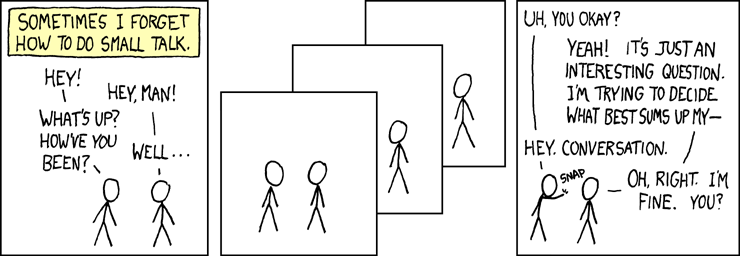
Phatic communication is a fancy term coined by the anthropologist Bronislaw Malinowski that means basically the same thing as 'small talk': communicative acts whose functions are primarily social, and not necessarily meant to convey information. It's easy to dismiss small talk as just so much useless blather, but we live in a world run by people, and so mastering the art of bullshitting is just as important as actually having something substantive to talk about!
Silence serves a complementary function to small talk in social settings. It can signal comfort or confidence, particularly in social settings where participants are close friends or intimates. On the other hand, silence induces anxiety in human beings, because it's often associated with danger and uncertainty; an example of this is classic film trope of someone walking in the woods, and all of a sudden, the birds stop singing. Silence and small talk are construed differently among cultures, but in general, small talk serves to lessen social distance, while silence tends to reinforce or increase it. Communication among people of different levels of social status tend to include less small talk, while communication among equals tend to include far more.
Small talk and social anxiety
Small talk is risky for those with social anxieties. It forces you to self-disclose, and that makes you vulnerable to being judged, but in reality, it's far worse to wall yourself up, because you relinquish control of how you're perceived by others. There's this binary trap that a lot of people with delayed social development fall into, which basically pigeonholes people into 'smart' and 'stupid', and falsely equates silence with profundity, but that oversimplifies the idea of intelligence.
In other words, most people are smart, but in very different ways, and just because you got a 340 on the GRE doesn't mean you're necessarily 'smarter' than someone who waits tables for a living, or panhandles, or sells used cars. All three roles take a keen ability to evoke certain emotional responses in people, and that takes practice. And so a large part of why this topic fascinates me is because the late development of my social skills relative to my other intelligences allowed me to consciously guide and reflect on the process of acquiring social skills.
How to get laid and influence people
One of the most important things I learned was that social skills aren't inherent or innate. They are learned skills. Anthropologists have a fancy word for that: enculturation. There exist very few things that are truly universal in human social life. Almost all human cultures consider incest, murder, and theft to be transgressions. Almost all human cultures grieve for the dead and use food as a nucleus for social activity. That's really about it. Ritual exchanges devoid of informational content along the lines of the classic 'how are you / I'm fine (even when you're not)' exist not only in mainstream North American cultures, but also world-wide, and can even can be observed in non-human animals, such as the contact calls of birds or the mutual butt-sniffing of dogs.
What this means is that while blooming late is not without consequence, it also doesn't mean you're doomed to a life of cringing awkwardness. I never went on a date until I was in my early twenties. Now I do all right. I used to freeze when I was expected to talk to strangers. Now I'm cracking jokes at conferences and happily bullshitting around in front of roomfuls of very smart people. I still have my moments, of course, when I feel like an utter social reject, but they're fewer and further between these days. So I empathize with the socially-awkward. I want to help.
 |
| Source: http://xkcd.com/222/ |
Sunday, January 6, 2013
Holding grudges.
It was the mud-splattered peak of the rainy season, and two monks, a master and his student, were on pilgrimage. They came upon a creek, and a woman standing alone on the banks. Despite the prohibition of their order against touching women, the master offered to carry the woman across the stream. When the three made it to the other side, the master bade the woman farewell, and the two monks continued on their way.
Finally, the student broke the silence, and asked the master: "Why did you so knowingly violate the rules of our order and carry that woman across?"
The master stopped and looked back over the road. He turned back to his student, cleared his throat, and replied: "I left her there at the river. Why do you still carry her?"

Finally, the student broke the silence, and asked the master: "Why did you so knowingly violate the rules of our order and carry that woman across?"
The master stopped and looked back over the road. He turned back to his student, cleared his throat, and replied: "I left her there at the river. Why do you still carry her?"

Subscribe to:
Posts (Atom)